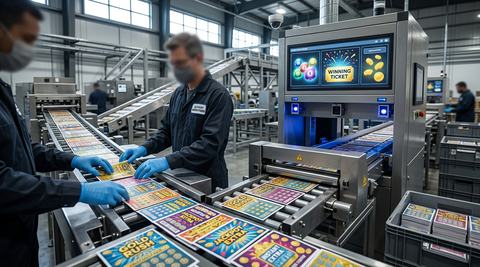
Image credit: Created by AI
What protects a scratch-off lottery ticket before it is sold?
Scientific Games and Florida Lottery requirements describe the software, coatings, testing and facility controls used to protect instant-game tickets before sale.
A scratch-off lottery ticket may look like a small piece of printed paper, but protecting it begins long before it reaches a store. Scientific Games has described a production system that combines secure software, controlled manufacturing, laboratory testing and physical safeguards to protect instant-game tickets.
The company, which says it has spent five decades engineering scratch-off games, discussed the design and manufacturing process in an interview with Lottery USA. Its account traces the modern secure scratch-game process to 1974, when Scientific Games created what it identifies as the world's first secure scratch game.
Game development brings together analytics, algorithms and creative design with software and manufacturing controls. Those systems are intended to prevent anyone involved in production from knowing which ticket is a winner before the covering is removed.
That covering is itself a carefully engineered part of the ticket. Scientific Games says scratch-off coatings must endure packaging, shipping and the handling that takes place in retail settings. At the same time, the coating must remain smooth and easy for a player to remove.
Quality-control laboratory experts test more than whether a ticket can be scratched. Scientific Games says its specialists evaluate ticket security, the performance of the coating and the overall scratching experience before the product is released.
The physical production environment adds another layer of protection. Florida Lottery requirements for instant-ticket vendors call for 24-hour central alarm monitoring and guards to be on duty whenever tickets are being produced or stored. The requirements also address the people working in those areas, including criminal and credit-history background checks for employees connected with ticket production and storage.
Access to the tickets and the materials used to make them is restricted under the Florida Lottery checklist. Production and storage areas must be locked and alarmed when they are unoccupied, while visitor access must be controlled. Printing plates must be kept securely, limiting access to equipment that is part of the ticket-making process.
Distribution and inventory controls continue after production. The requirements call for cartons to be sealed sequentially, shipping manifests to document movements, and scrap game materials to be accounted for or destroyed. Those measures create records around tickets and related materials as they move from manufacturing to storage and shipping.
Readers tracking drawings and other lottery activity can consult the latest lottery results page. For scratch-off games, however, the protection of a potential winning ticket starts well before the result is revealed: it depends on coordinated digital, manufacturing, laboratory and facility controls.