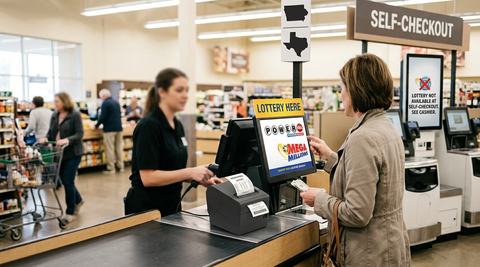
Image credit: Created by AI
Lottery sales move toward checkout lanes, but self-checkout remains a separate model
Official lottery programs in Iowa, Texas and Ontario, along with California planning discussions, show different approaches to selling tickets at checkout without confirming a broad U.S. self-checkout rollout.
Lottery sales are moving into more checkout settings, but the official programs documented in Iowa, Texas, California and Ontario represent different retail models rather than one broad self-checkout rollout. Some programs use cashier-operated registers, one has been discussed as a future point-of-sale option, and another uses customer-operated terminals with age verification and purchase limits.
The Iowa Lottery debuted its Easy Play option at select Fareway stores on March 12, 2025. Easy Play allows customers to purchase quick-pick Powerball and Mega Millions tickets at checkout lanes staffed by cashiers, creating an alternative to buying those tickets at a traditional lottery terminal.
Iowa planned to expand Easy Play by the end of March 2025 to every Fareway location in Iowa that sells lottery tickets. The planned expansion would make the checkout-lane option available across the participating Fareway network in the state, while still tying availability to stores that already sell lottery tickets.
Easy Play tickets use the same type of paper used for store receipts. The lottery tickets are printed separately, however, so they are not simply ordinary purchase receipts with lottery information added to them.
Customers can use Easy Play to buy one, two, three, five or 10 quick-pick plays for the next Powerball or Mega Millions drawing. The customer chooses the number of plays, while the numbers are generated as quick picks rather than selected manually at the register.
The Iowa program does not support Power Play, Double Play or Megaplier add-ons. Its available purchases are therefore limited to the specified quick-pick Powerball and Mega Millions plays without those additional features.
Easy Play purchases must be made with cash or an equivalent payment method rather than credit. Although the product is available at a checkout lane, the payment restriction remains part of the program's design.
The Iowa option is not available at self-service checkouts. That distinction separates Easy Play from a customer-operated self-checkout lottery system: the purchase takes place at a cashier-staffed lane, not at a register operated by the customer. Readers looking for current draw information can consult the latest Powerball results and latest Mega Millions results.
Texas uses another cashier-lane model through its Receipt Ticket program. Participating retail registers sell Powerball and Mega Millions quick picks in-lane, allowing the lottery purchase to be handled through the store's register rather than a separate lottery terminal.
Texas Receipt Tickets are official lottery tickets. They include a barcode and are printed by the store cash register, combining the register-based purchase process with a ticket format that can be checked after the transaction.
The Texas Lottery identifies July 21, 2020, as the launch date for the nation's first in-lane Receipt Ticket at participating H-E-B Business Centers. That date places Texas's register-based model before the Iowa Easy Play debut, although the two programs use their own names and operating details.
Receipt Tickets can be checked through the Texas Lottery app, self-service vending machines or Check-a-Ticket machines. Those options give purchasers several ways to check a ticket after it has been printed at the participating register.
California has discussed possible in-lane delivery models without a confirmed statewide rollout in the documented material. The California State Lottery considered Quick Ticket products with a gift-card-style format and receipt tickets printed through retailer point-of-sale systems.
The California discussion covers two different ways an in-lane product could reach customers. One would use a Quick Ticket product designed in a gift-card style, while the other would use the retailer's point-of-sale system to print a receipt ticket.
Ontario Lottery and Gaming operates a more direct self-serve model. Its secure self-serve lottery terminals allow customers to buy selected draw-based and instant lottery products through a self-checkout process.
Ontario's terminals require an identification scan to verify that the purchaser is at least 18 years old. The age check is built into the self-serve process rather than being described as a cashier-lane purchase requirement.
The Ontario terminals accept debit and credit cards, including cards stored in Apple Pay and Google Wallet. They do not accept cash, creating a payment model that differs from Iowa Easy Play's requirement for cash or an equivalent payment method rather than credit.
Ontario limits self-serve lottery purchases to $300 per customer session. Ontario Lottery and Gaming says the machines supplement traditional lottery terminals rather than replacing them, so the self-serve option operates alongside the established retail channel.
Taken together, the programs show that alternative lottery purchasing channels can mean several different things. Iowa and Texas place lottery sales at cashier-operated registers, California has discussed possible in-lane products tied to retailer point-of-sale systems, and Ontario operates secure customer-operated terminals with identification checks, electronic payments and a session limit.
The official programs do not establish that lottery tickets are broadly sold through customer-operated self-checkout lanes across the United States. Iowa's Easy Play program specifically excludes self-service checkouts, while the Texas and California examples center on cashier-operated or proposed in-lane systems. The documented evidence therefore supports a comparison of emerging retail models, not a confirmed nationwide expansion of self-checkout lottery sales.